
May 8, 2025
The recently signed Minerals Deal between the US and Ukraine is more favourable to Ukraine than many European commentators had assumed, and the US is using more positive language towards Ukraine. This seems encouraging, but what might it mean for the chances of a peace agreement and beyond?
President Trump’s approach to negotiating as a form of leveraged bargaining makes the next steps hard to read. But our own analysis identifies some key constraints which allow us to make some calls about the probability of future outcomes.
Despite any short-term optimism following the Minerals Deal, Europe needs to make the culturally alien but now long overdue decision to create the type of hard power that will deter future Russian aggression. Europe should assume that from now on it has to deal with Russia without American help and to be seen by Russia as a credible adversary.
Russia is building its military forces in the Leningrad Military Region, and with or without a peace agreement in Ukraine, it will continue to do so. Europe needs to prioritize deterrence against this scenario now, to the extent that Russia understands that the consequences to itself of future aggression against a NATO member state are unacceptable.
Will Trump’s Plan for Peace Work?
The strategy of the US Administration is based on the belief that security is about deals between spheres of influence, an approach that might accurately be called leveraged bargaining rather than diplomacy. This is an unpopular strategy in Western Europe, but ethical objections aside, might it actually succeed in achieving a lasting peace? Probably not.
Whilst we think that there are better than even odds of a peace deal between Ukraine and Russia, and of a minerals deal between the US and Russia, it seems very unlikely that this will result in any sustainable peace. There are at least 3 factors that support this conclusion:
- The minerals deal only offers Ukraine vague security guarantees, and the US can walk away at any time. Europe doesn’t have the option of walking away.
- Europe has offered whatever support Ukraine needs, but so far there is no real evidence that the Europeans are committed to the creation and exercise of hard power to an extent that would deter future Russian aggression. Whether or not Europe does this is a key factor is estimating likely outcomes over the longer term.
- Russia’s attitude towards the sovereign independence of Eastern European states is unchanged and is sharply opposed to our own. Overlapping with this, Russia still believes that NATO ‘encroachment’ is a real threat to Russia and is a justification for future conflict.
“It’s quite possible that Trump forces the guns to stop firing for long enough to claim victory, then to leave. This should be our planning assumption”
– Sir Alex Younger, former head of MI6.
Russia is Rearming Outside of Ukraine
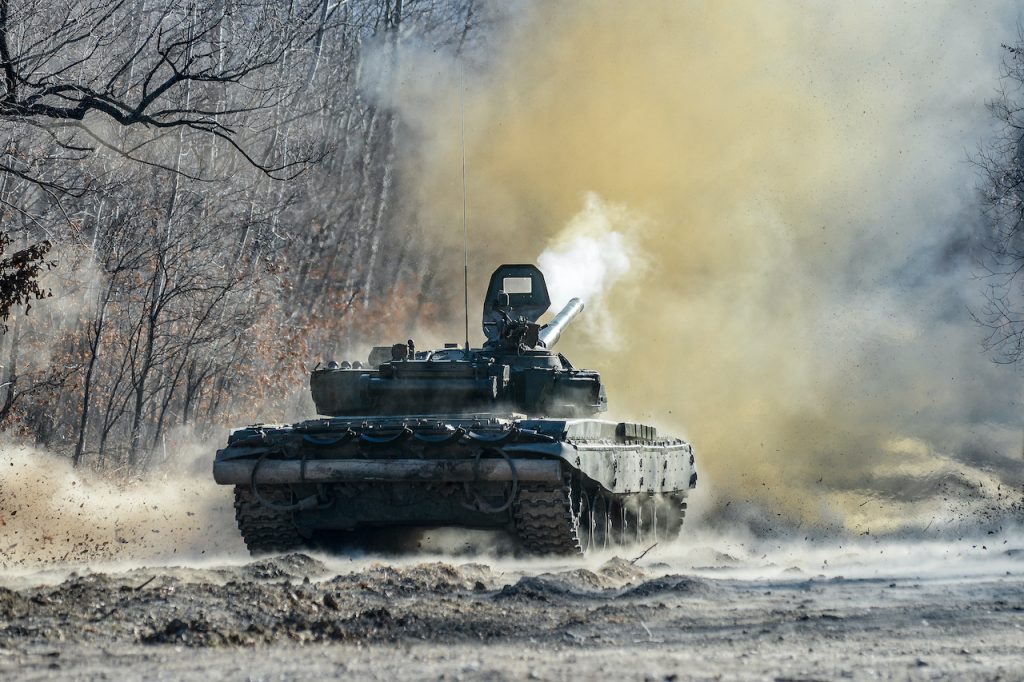
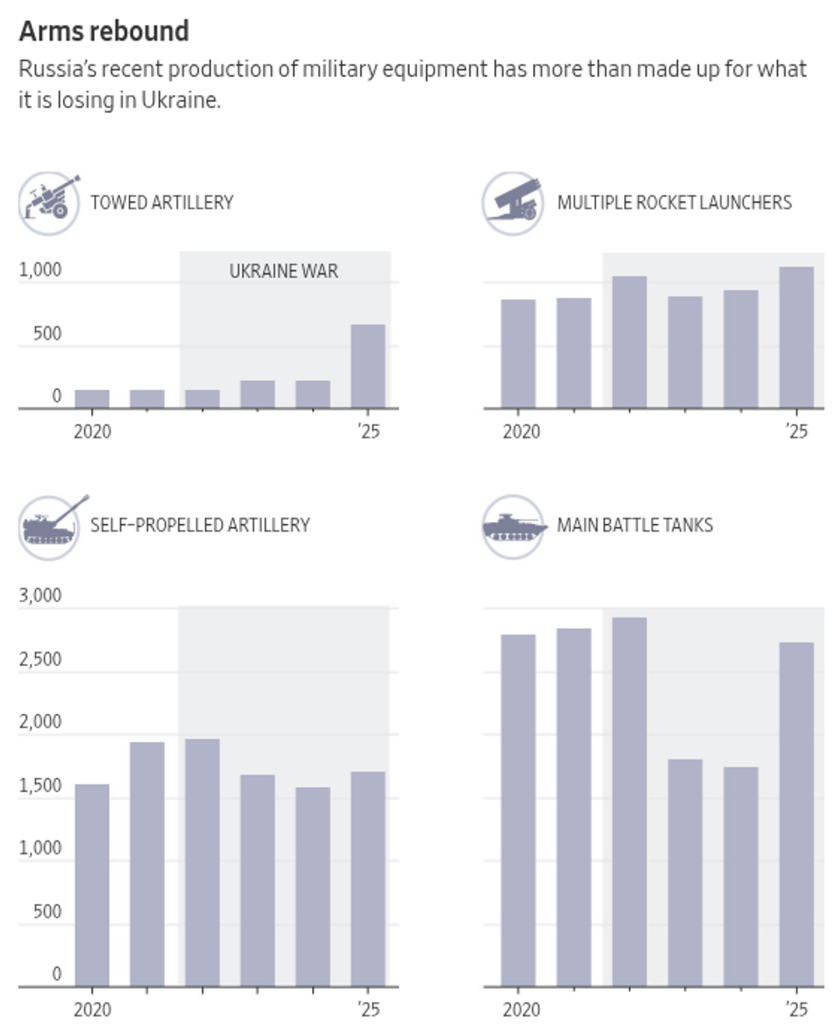
Very rarely at present are newly built Russian vehicles observed or destroyed in Ukraine, leading many Western commentators to question Russia’s ability to sustain attritional war. But this misses the wider issue of Russia’s arms manufacturing rebound within Russia, especially its reorganization of the Leningrad Military Region, bordering Finland and Estonia. As the charts on this page show, Russian arms production in 2025 is on the rise.
Russia is not struggling to recruit troops either:
- The US estimates that around 30,000 Russians are signing up each month, up from 25,000 last summer. Some Eastern European officials put this figure at 40,000 per month.
- According to European intelligence assessments, the extra manpower is allowing Russia to build new units within Russia itself.
- Those units will get much of the new hardware Russia is producing. Most of what is being observed and destroyed in Ukraine is old and refurbished Soviet-era weaponry.
In the realistic worst-case scenario that the US decides to walk away, Europe will be forced to stand up and deal with the very real prospect of a Russian incursion into a small NATO country. In previous articles we said that Estonia would be the likely target of a Russian attempt to test the alliance’s cohesion: this analysis is unchanged, with an incursion through Belarus into Lithuania also a possibility.
Poland is acting on the assumption that this is probable (55-75%) in as little as three years. We would downgrade the threat to Poland itself, but we do think a threat against the Baltic States becomes increasingly probable five years from now.
A Sustainable Peace?
Ascribing a probability to the success or failure of a peace agreement is one of those rare cases where it is impossible to set biases aside entirely – opinions are sharply divided and there is no reliable evidence to determine in advance which view is more likely to be correct.
Even in the ‘West’ views are sharply divided. The American administration appears to think that there is a realistic possibility of its strategy achieving a sustainable peace through a sort of balancing of commercial interests, with America as the partner-in-common. Europe on the other hand is more bearish; based on its deep mistrust of Russia’s motives, the Europeans seem to think there is almost no chance of a sustainable peace without unequivocal US security guarantees – and about these there are few grounds to be confident at present.
Our own assessment falls somewhere between the American and European positions. We see a realistic (but qualified) possibility for a sustainable peace between Ukraine and Russia, with a probability of around 40%. However, we also agree with the European position that Russia will continue to pose a threat to Europe beyond any cessation of fighting in Ukraine. We think this is almost certain.
In any case, this underlines the need for Europe to quickly create its own capability to exercise hard power, to the extent that it can deter future Russian aggression against Europe itself, and as a way of influencing Russian courses of action away from conflict.
What could those Russian courses of action look like?
Hybrid Challenges
Irrespective of whether the American or European view turns out to be right, it seems highly likely (80 – 90%) that Europe will have to deal with a significant Russian challenge in the hybrid space without American help. And Europe’s more direct exposure to this will force it to make highly consequential choices about its commitment to creating and exercising the type of hard power that could constrain Russia.
With or without a peace agreement, Europe should assume that Russia will expand the range of its hybrid activities to include:
- Destabilizing interference in Georgia and Moldova, even extending to direct action.
- Probing into the Russian speaking communities in the Baltic States.
- More disruption, sabotage and disinformation within Europe itself.
The ‘Expeditionary’ Threat from Russia
Russia’s build-up of military power in the Leningrad Military Region bordering Finland and Estonia does not necessarilylead to a certainty of armed conflict between Russia and NATO. But it does force Europe to confront a very realistic longer-term threat.
The key factor in reducing the probability of conflict is whether Europe up-arms quickly enough to constrain Russia – in other words, to convince Russia that even a probing incursion into a small NATO member state would have unacceptable consequences for Russia.
If Europe does not achieve this level of deterrence independently of the US, the probability of an armed incursion by Russia is at least probable (55-80%) within as little as five years.
Europe’s Response
Three key actions are needed to shift Europe away from dependence on America and towards independent resilience:
- Collectively increase defence spending to a minimum of 3% of GDP. At the same time, use diplomacy to signal to Russia that European up-armament is defensive. Europe has consistently misunderstood the depth of Russia’s concerns about NATO encroachment. Careful diplomacy is needed to identify opportunities for positive engagement where possible.
- Prioritize re-establishing Europe as a global leader in emerging technologies. Russia might win on quantity, but Europe must be able to far outperform Russia in the quality of its military technology.
- Individual countries need to organize for total defence, especially against the range of hybrid threats. We welcome the recent establishment of the UK’s Resilience Academy and look forward to its future contribution to whole of society resilience.
Back to Insights
Share this insight